

Today
Friday, November 6 · coastal California · fall
Put the garden to bed
Treat the soil, not the symptoms™. Here's what to do now, and why.
This season
Put the garden to bed
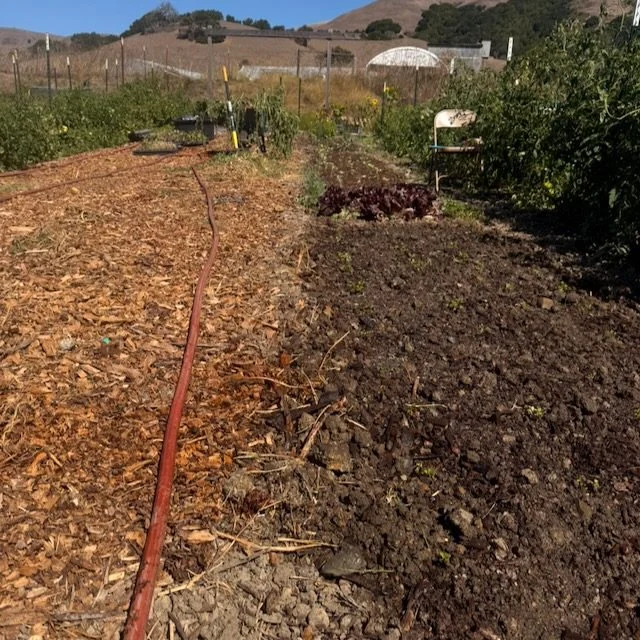
Pull the spent summer plants, open the soil gently with a fork, and cover it before the rains come.
Bare soil is a wound, so don't leave it open over winter.
How to do it →membersRead the full explanation
Pull the spent plants and weeds, and put anything that looked diseased in the green bin rather than your compost. Old plants are winter shelter for the pests and spores you don't want back in spring.
Then push a garden fork into the bed and rock it back gently to crack the soil open. Don't flip it over. The fungi in your soil have spent all season building threads that hold the soil together and carry water and nutrients to roots, and turning the soil tears that network apart.
Finally, cover the soil: straw or leaves on vegetable beds, a cover crop with the first rains. Rain and sun strip the life from bare soil, it crusts and erodes, and you start spring behind. You've got it right when you can't see bare dirt anywhere.
This season
Sow cover crops with the first rains
When the first fall rain soaks in, sow a mix of grasses, legumes, brassicas and other broadleaf plants together.
Living roots feed your soil all winter, and the rain does the watering.
How to do it →membersRead the full explanation
A cover crop is grown to feed and protect the soil, not to harvest. Sow it right after the first real fall rain, so you don't have to water.
Christine Jones showed that living roots pump sugars made in the leaves down into the soil, where they feed fungi and bacteria. She calls it the liquid carbon pathway. Different plant families feed different microbes, so a mix of grasses, legumes (peas, beans, vetch, clover), brassicas (mustards, radishes) and other broadleaf plants feeds far more soil life than one species.
Coat legume seed with its matching inoculant before sowing, so it can pull nitrogen from the air. Skip the cover and the soil life that feeds next year's plants goes hungry all winter. You've got it right when the bed turns into a green carpet of several different leaf shapes.
This season
Plant garlic
Plant garlic everywhere your beds allow: edges, corners, between perennials.
It holds the ground through winter with almost no work and pays you back in early summer.
How to do it →membersRead the full explanation
Fall is garlic time in coastal California. Push cloves in, pointy end up, anywhere you have space: bed edges, corners, between perennials.
Every living root keeps feeding soil life through the cool months, and garlic is about the easiest root there is to keep alive through winter. It asks for almost nothing until it's time to harvest.
Wait until spring and you've missed the window; garlic needs the winter chill to form good bulbs.
This season
Send in a soil test
Test now, so the report is back and any minerals your soil truly needs can go in before next season.
Measure first, add second. Don't lime or add gypsum out of habit.
How to do it →membersRead the full explanation
Take small cores from several spots in the bed at the same depth, mix them into one sample, and send it in. Fall testing means the results are back in time to act on before spring planting.
A garden can be short of one mineral and loaded with another, and you can't see which by looking. William Albrecht showed that the balance matters as much as the amount: adding more of something that's already high pushes other nutrients out of reach. That's why nothing mineral, not even gypsum or lime, should go on before the report comes back.
Guess instead, and you risk making the real shortage worse. You've got it right when the sample goes out before the heavy winter rains.
This season
Order seed catalogues
Mark next season's varieties while this year is still fresh in your head.
Planning now keeps spring from turning into a scramble.
How to do it →membersRead the full explanation
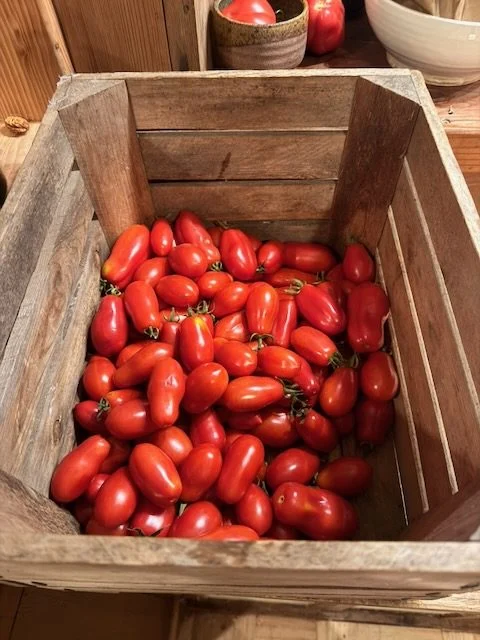
Right now you remember which tomato split, which bean fed you all summer and which bed got too much shade. By spring you won't.
Get the catalogues, write down what worked and what didn't, and mark what you want to try. The good varieties sell out early, and a list made now means you plant what you chose instead of whatever's left on the rack.
Water and biology
Extract goes on fresh
Get your extract onto the soil within 4 hours of making it.
Make only what you'll use today, because the life in it starts dying off fast.
How to do it →membersRead the full explanation
A compost extract is a living population pulled out of the compost into water with no food and falling oxygen. The numbers start dropping within hours.
Make only as much as you'll use that day, and get it on within 4 hours. Anything older has lost much of the life you made it for, and you're watering with expensive brown water.
(A continuous flow extractor batch on a big site can hold 24–48 hours in a clean, cool tank, but fresher is always better.)
Water and biology
Keep living products away from anything that kills cells
Oxidizers, copper and bleach kill the life in your extract, Quick Sol clumps in a mixed tank, and hot soil or old extract wastes it.
Five rules keep your biology alive from bucket to root.
How to do it →membersRead the full explanation
Keep living products away from anything that kills cells. Hydrogen peroxide, bleach, ozone, UV line flushes and chlorine dips are oxidizers. They work by ripping electrons off whatever they touch, which tears apart cell walls and membranes. That's great for sterilizing a pruning saw, and a disaster for the fungi, bacteria, protozoa and nematodes in your extract. If you've cleaned lines, trays or tanks with any of these, flush with clean water and give it two full days (48 hours) before any extract, algae or other biological goes through.
Never mix extract with copper or bleach. Copper is a broad spectrum fungicide that kills fungi on contact, beneficial ones included, and bleach is an oxidizer. If you must use copper for a disease emergency, keep it on a separate day and a separate sprayer, and follow it later with fresh extract.
Quick Sol always goes on alone. It's a polymer silicon that thickens and clumps (coagulates) in a mixed tank, clogs nozzles and emitters, and stops working. Give it a day's gap on either side of your biologicals.
Don't drench biology into hot soil or media. Above about 85°F in the root zone or a pot, the organisms in your extract are stressed or killed, while Fusarium speeds up above 75°F. Drench at first light or in the evening, run the line until the water is cool, and shade dark containers.
Extract is fresh food: use it within 4 hours. After that, much of the life you made it for is gone.
Recap: no biologicals within 48 hours of an oxidizer · never extract with copper or bleach · Quick Sol alone · no drenches above 85°F · no extract older than 4 hours.
Garden care
Keep roots cool
On hot days, aim to keep the root zone at 65–72°F.
Root disease speeds up above 75°F, while the beneficial life slows down.
How to do it →membersRead the full explanation
Heat favours the pathogen. Above 75°F in the root zone, organisms like Fusarium speed up while your soil's helpers slow down.
Water early, let hose water run until it's cool, mulch to shade the soil, and shade dark pots. You've got it right when a soil thermometer at root depth stays in range through a hot afternoon.
Garden care
Weekly root scout
Healthy roots are white or cream, firm and branched.
If 1–2 plants wilt and water doesn't fix it, pull one and look. Brown tissue inside the stem means act now.
How to do it →membersRead the full explanation
Stunting and yellowing are often mistaken for a nutrient shortage when the real problem is at the roots. Pull a plant and look before you change the feed.
Watch: 1–2 plants yellowing or wilting in a way water doesn't fix, or a few brown root tips. Act now: brown tissue inside the stem, a lesion at the crown, root skin sliding off, or more than one plant wilting in the same area.
Write down your call each week: Normal, Watch or Act now. Catching it at Watch gives you time to act.
Tell us where you grow and what feeds your table. We'll sharpen these cards, free.
Start the intakeOG of the day
“Coros Institute and Rudolf Steiner College; Sacred Agriculture. Plant alchemy, the preparations, and weather and climate work.”
Dennis Klocek →Compost cam
Members can watch the windrows work. Join the club